






How does a Formula 1 team prepare for a completely new race on the calendar? That question is more relevant than ever, with the first edition of the Spanish GP at the still unused Madring just around the corner. In the search for answers, McLaren offers a behind-the-scenes look.
Read more Audi appeals against Yuki Tsunoda’s impunity: ‘Should have started Italian GP from the pit lane’
The teams’ preparation has been ongoing for a long time. McLaren reports that it has made extensive use of the simulator to learn the layout of the circuit and thus determine an initial direction for setting up the MCL40. The drivers were also able to prepare for the new circuit this way. Something that is no different for other teams, by the way.
“A completely new circuit in Madrid offers both a huge opportunity and a risk,” says McLaren’s performance director Mark Temple. “We have solid simulation data regarding the layout of the circuit, energy consumption, and aerodynamics. But the biggest variable remains the behavior of the tires on this new asphalt.”
The simulator simply (fortunately) cannot predict everything. How much grip the new Spanish asphalt actually offers, how the tires behave, how much energy can be used, and where overtaking is possible; all of this must be discovered in practice. It is also still unknown how the track will evolve over the weekend.
Free practice crucial
That is precisely why the first free practice sessions are crucial according to McLaren. The data from the simulator must be compared as quickly as possible with what actually happens on the circuit. Based on that, the engineers can further adjust the car and adapt their approach.
According to Temple, the grip level is especially a big question mark. “The conditions of the asphalt during the free practice sessions on Friday will be crucial, we need to try to understand where and why you have grip in order to shape the rest of our weekend.”
Read more Fernando Alonso on growing F1 popularity in Spain: ‘My greatest legacy’
Added to that is the character of the Madring. The circuit is tight and requires a lot of stability when braking, also during corner entry, according to Temple. In the slow sections, it is important to use the kerbs well, while there are also some fast corners that present their own challenges.
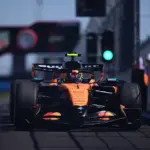
McLaren is bringing some small aerodynamic updates for the MCL40 to Madrid. The so-called H-Wing, introduced during the Italian Grand Prix in Monza, is absent at the Madring.
‘Adapt’
Because the differences between the top teams have been small in recent months, the ability to adapt quickly this weekend can play an important role. On a new circuit, not only the speed of the car is decisive, but also how quickly a team understands what is happening under its car.
“New circuits reward the teams that adapt the fastest,” says Temple. “Our goal is to gradually build confidence and performance during each session and on Sunday, when it counts, to achieve the maximum result.”
The first real answers of the weekend will follow on Friday, as soon as the simulator gives way to reality.
Read more VIDEO: Max Verstappen drives first digital lap at Madring: ‘Hope this doesn’t happen in real life’
Read everything about the Spanish GP here