Because they did not agree with the new FIA contract provisions at the beginning of 1982, all Formula 1 drivers initially refused to race during the Grand Prix weekend in South Africa. On the orders of strike leader Niki Lauda (photo above), they even barricaded themselves in a hotel in Johannesburg. A reconstruction.
Read more Andrea Stella finds a peculiar problem with Oscar Piastri: ‘He drives and thinks’
After the dramatic conclusion in the battle for the world title, motorsport fans were already looking forward to the new Formula 1 season at the beginning of 1982, which promised plenty of excitement and spectacle. Would the powerful turbos finally take control in Formula 1? Renault, Ferrari, and Brabham (BMW) now had a turbo at the rear.
McLaren was waiting for the Porsche turbo, but for 1982 they had another ace up their sleeve: Niki Lauda! After three years of absence, the Austrian champion made a surprising comeback in Formula 1. Reportedly for an exorbitant salary of two million dollars. ‘How do I know if you’re still fast enough?’ team boss Ron Dennis asked cautiously. ‘Then just give me one dollar for driving and the rest for publicity value,’ Lauda replied.
The Austrian knew very well what Formula 1 needed in the early eighties: a superstar, a leader. Alain Prost, Nelson Piquet, and Didier Pironi were still too young, Jacques Laffite too cheerful, René Arnoux, Keke Rosberg, and Gilles Villeneuve too wild. But when the first free practice was supposed to start in South Africa at the end of January, it was silent at Kyalami. All drivers had disappeared…
Rebels
What happened? The trouble started in the winter. Drivers had to sign an agreement before the season began to receive their super license. Those who did not sign, the accompanying letter stated, would not participate in the race in South Africa. The agreement, from the FIA and FOCA (Formula One Constructors Association), included a clause stating that drivers, like footballers, would become the property of the teams for a number of years upon signing a contract.
No driver had read the document, let alone thought about it, except Niki Lauda. Lauda understood that this clause severely restricted the freedom of the drivers and raised the alarm. Through Pironi, chairman of the GPDA (Grand Prix Drivers Association), he called on everyone not to sign. To the displeasure of the FIA and FOCA chairmen, Jean-Marie Balestre and Bernie Ecclestone.
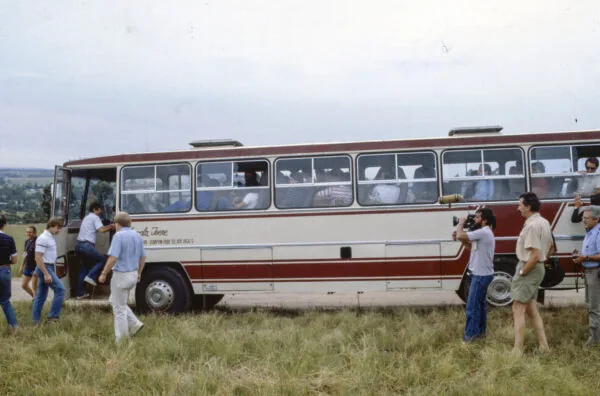
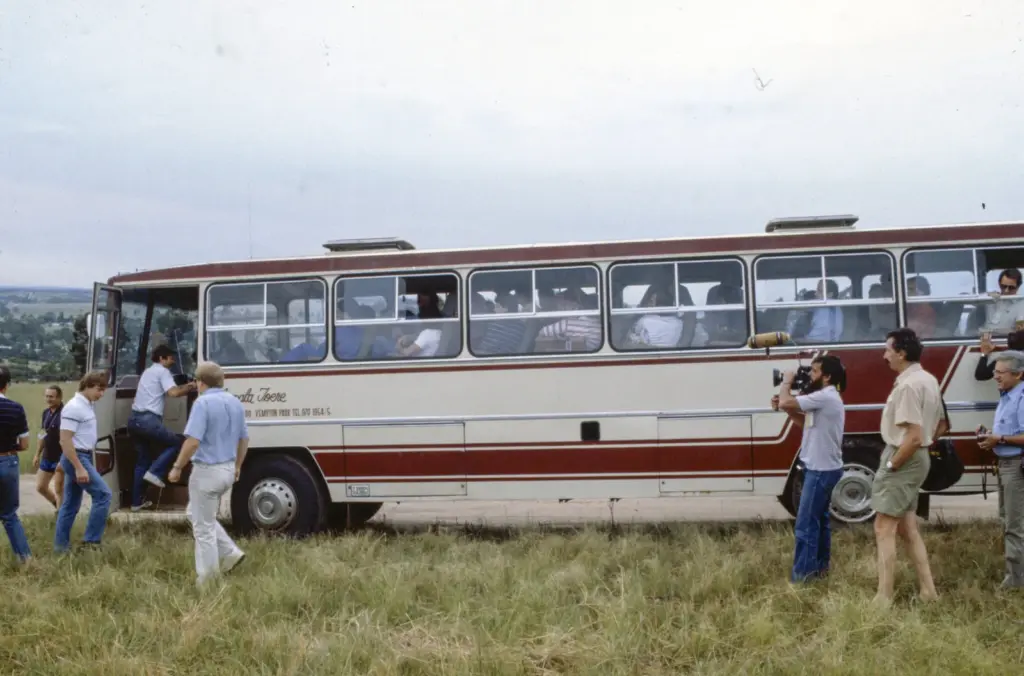
Before the race weekend, frantic consultations took place, but none of the parties wanted to give in. The organization became nervous. When the first free practice was supposed to start on Thursday morning, all drivers had left, by bus. Led by Niki Lauda.
Lauda, who had been in Formula 1 for more than ten years, now knew how it worked. Every time the drivers wanted something against the wishes of the FIA or organizers, their protest was crushed by threats from the teams or the organization. Often it was the younger (or lesser) drivers who feared for their future in Formula 1 and agreed to get in their cars.
For example, this happened in 1975 in Barcelona, when the guardrails along the track were not properly secured. The drivers initially refused to race until, after some patchwork and numerous threats from the organizers, one by one they eventually went out on the track. The outcome is known: during the race, Rolf Stommelen’s car flew over a guardrail, killing five people. That’s why, Lauda knew, they had to operate as one block. And especially stay out of the clutches of the bigwigs and team owners.
That’s why he gathered all the drivers in a bus and they left the circuit. Only Jochen Mass was not there because he was staying at his in-laws. But he would also refuse to race.
March team boss John McDonald tried to block the circuit exit with a van, but Laffite immediately jumped out of the bus, pushed the van driver aside, and cleared the way.
The rebels drove to the Sunnyside Park hotel in Johannesburg, more than thirty kilometers from the track. A caravan of journalists and photographers followed. In the hotel, the drivers locked themselves in the party room, which Lauda had already arranged. At the circuit, Pironi negotiated until the last moment, but when no one gave in, the first free practice was canceled. The Formula 1 drivers were on strike.
Officially, it was not called a strike (that would cause legal problems); the drivers felt ‘unable to race’ because they were under pressure. Pironi shuttled back and forth. It was a time without internet and smartphones. The disappointed crowd at Kyalami briefly perked up when an engine was started and Elio de Angelis seemed to be in his Lotus. However, it turned out to be a team member who had jokingly put on De Angelis’s helmet.
Bernie Ecclestone, who was also Brabham’s team boss, was furious and threatened to fire his drivers Piquet and Patrese. Frank Williams laughed and said he was ready to take over the duo. Mega fines were threatened, but the drivers stayed in the hotel. The super license document had to be scrapped.
Read more Official Formula 1 calendar 2027 announced: number of sprint races increases to ten
Terrorism
When the second free practice was also canceled, the names of the thirty drivers who were immediately expelled were read out at the circuit. The organizers had already proposed postponing the race to find thirty new drivers! Meanwhile, in the hotel’s party room, Laffite was clowning around and Bruno Giacomelli was imitating Balestre and Ecclestone, much to the amusement of the others. They played football with an improvised ball, Carlos Reutemann was the goalkeeper. At eight o’clock, food was brought: prawn cocktail, fried chickens, ice cream, and coffee. Villeneuve tinkled a bit on the piano, Elio de Angelis even gave a full concert; the Italian had given up his calling as a concert pianist for Formula 1. Finally, Giacomelli gave a lecture on terrorism, drawing various types of automatic weapons on a board.
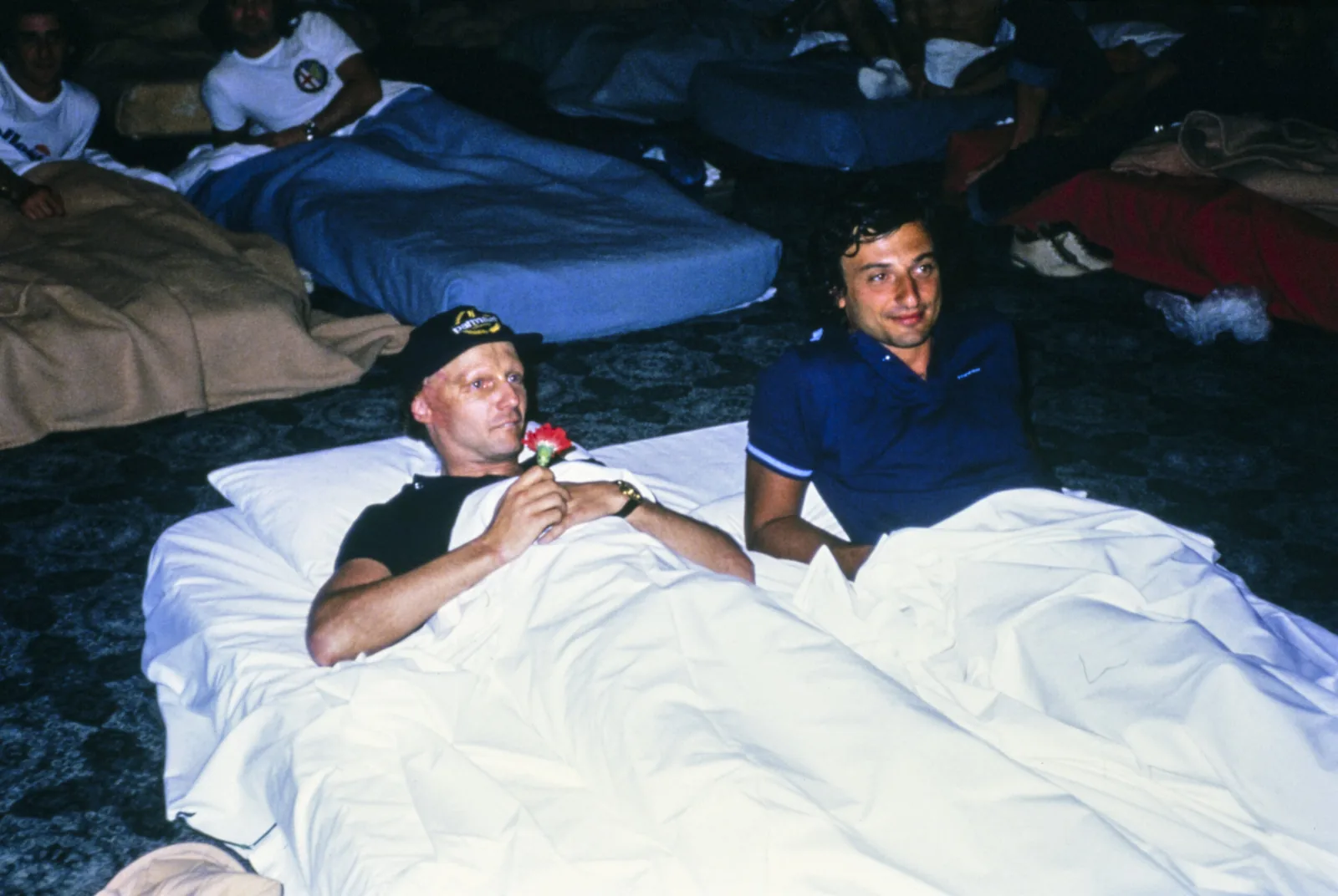
As it got late, some drivers started to get a bit nervous. A few wanted to talk to their girlfriends and then heard that their team boss had assured her that her boyfriend would be immediately fired after this weekend. Arrows team boss Jackie Oliver was said to have even rented a wardrobe to smash and break the strike. The door was barricaded with the piano. Lauda had meanwhile arranged a dormitory, and at midnight the thirty drivers crawled into their beds, on mattresses on the floor. The atmosphere was like a school camp in high school.
Niki Lauda urged the biggest cowards: they had to remain united; only then would Ecclestone and Balestre have to give in. Rosberg was already snoring. Everyone who needed to go to the bathroom was closely watched at night. Lauda and Pironi kept watch. Max Mosley, one of the drafters of the controversial document, would later state: “The problem was Lauda, he was the only one who understood everything.”
In the morning, Theo Fabi left anyway; he no longer dared to stay. He was shunned for the rest of the weekend.
On Friday morning, there was another meeting at the circuit. Pironi returned with the message that there would be racing. Balestre and Ecclestone had given in. Well, given in… a ‘ceasefire’ was agreed upon. For now, nothing had to be signed. Relieved, the drivers got back on the bus to return to the circuit. They still had one free practice before qualifying.
However, at the beginning of the week, extensive testing had already taken place at Kyalami, and the setups were already in order. The team bosses were still angry. Mo Nunn withdrew his Ensign. Ecclestone did not let Piquet drive in practice, saying he would be too tired from all the craziness. Patrick Tambay, who was to make his comeback at Arrows at Kyalami, had already had enough of Formula 1 and quit. Brian Henton was ready as a reserve driver.
Suspensions
Kyalami is at high altitude, so the race became a prey for the turbos. The Renaults of Prost and Arnoux led the dance. Piquet was already in the barriers after four laps. When Prost got a blowout halfway through the race, the battle seemed over. However, Prost made it to the pits, changed all four tires, taped up the damage with duct tape, and, nearly a whole lap behind, started the chase. With a knife between his teeth, he drove one fast lap after another. Ultimately, his fastest lap was one and a half seconds faster than his teammate and two seconds faster than the fastest Ferrari, driven by Pironi. Arnoux struggled with his tires. He should have gone to the pits too, ‘but the finish is so close…’.
With ten laps to go, Alain Prost regained the lead and won one of the best races of his career (of course overshadowed by the strike troubles). Reutemann and Arnoux completed the podium. Lauda finished fourth in his comeback, Rosberg fifth. Remarkably: the Finn’s gear lever head had broken off; the thing rolled back and forth somewhere between the pedals the whole race. Formula 1 in 1982.
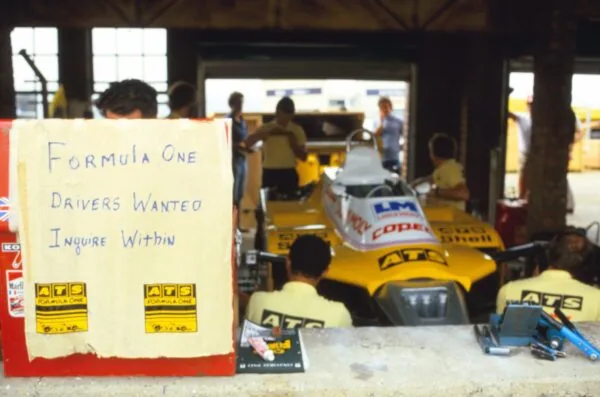
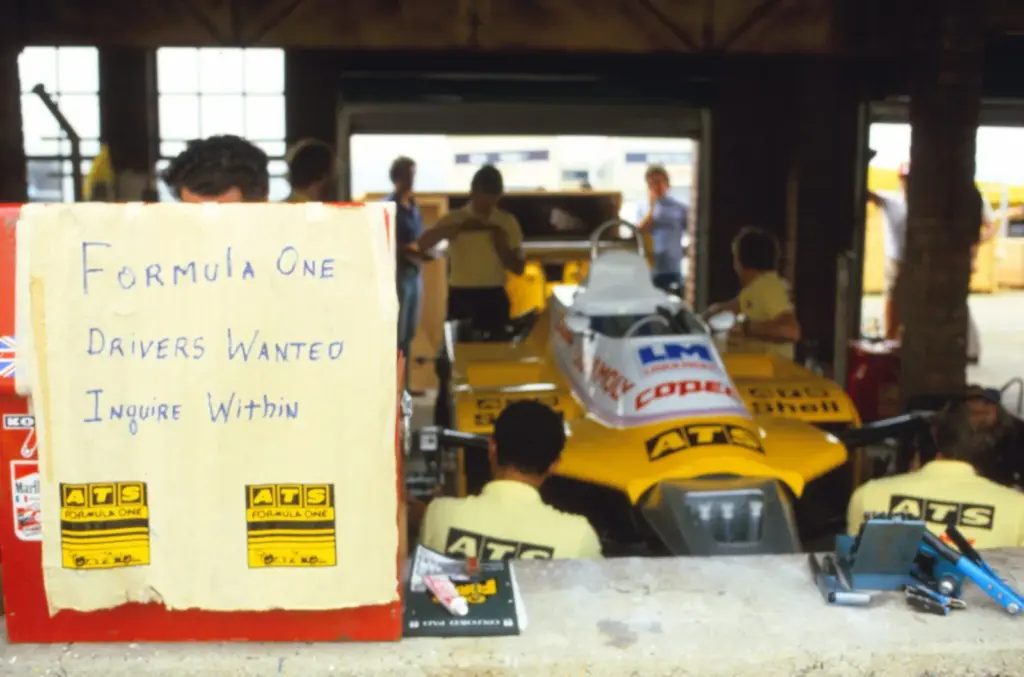
Afterwards, the FIA got its revenge. It was announced over the public address system that the super license of all present drivers had been revoked. Team bosses helped spread stories that their drivers had sometimes been held against their will and even with violence in the Sunnyside Park hotel. Heavy fines were imposed, from five to ten thousand dollars (yes, that was a lot back then), as well as conditional suspensions. Niki Lauda shrugged: “Should we still fight this?”
More than a month later, the FIA Appeals Council declared these penalties unfounded, halved the fines, and lifted the suspensions. Because the teams, especially Renault, feared losing their drivers in a next confrontation, the super license document was shelved by Balestre. At the next Grand Prix, at the end of March in Brazil, it was never mentioned again. The drivers had won their battle.
Cheating
The drivers’ strike in South Africa turned out to be a fitting prelude to the 1982 Formula 1 season. It became one of the most bizarre and tragic seasons in the history of Formula 1. Balestre and Ecclestone clashed over who was actually in charge of the premier class. Boycotts followed, cheating with water tanks, disqualifications, a race with only fourteen participants, a crazy race in Monaco, betrayal at Imola, and several terrible crashes, two of which were fatal. Fan favorite Gilles Villeneuve died at the Zolder circuit, rookie Riccardo Paletti in Canada.
Pironi, who seemed on his way to a certain world title, also crashed heavily and was never the same again. The world title went in the season finale, in the parking lot of the Caesars Palace hotel in Las Vegas, to a driver who only won one Grand Prix, in a turbo-free Williams: Keke Rosberg. The strike in South Africa echoed for years.
Read more Official: GP Monaco will become a sprint weekend for the first time in 2027
Source (among others) Heinz Prüller, Grand prix story 82. Peters’ Uitgeversmij, Deventer.
Who were the drivers who successfully went on strike? Who still remembers them all?
- 1 Nelson Piquet, Brabham-BMW BT50
- 2 Ricardo Patrese, Brabham-BMW BT50
- 3 Michele Alboreto, Tyrrell-Ford 011
- 4 Slim Borgudd, Tyrrell-Ford 011
- 5 Carlos Reutemann, Williams-Ford FW07
- 6 Keke Rosberg, Williams-Ford FW07
- 7 John Watson, McLaren-Ford MP4
- 8 Niki Lauda, McLaren-Ford MP4
- 9 Manfred Winkelhock, ATS-Ford D5
- 10 Eliseo Salazar, ATS-Ford D5
- 11 Elio de Angelis, Lotus-Ford 87
- 12 Nigel Mansell, Lotus-Ford 878
- 14 Robert Guerrero, Ensign N180
- 15 Alain Prost, Renault RE30
- 16 René Arnoux, Renault RE30
- 17 Jochen Mass, March-Ford RM821
- 18 Raoul Boesel, March-Ford RM821
- 20 Chico Serra, Fittipaldi-Ford F8
- 22 Andrea de Cesaris, Alfa-Romeo 179
- 23 Bruno Giacomelli, Alfa-Romeo 179
- 25 Eddie Cheever, Talbot-Matra JS17
- 26 Jacques Laffite, Talbot-Matra JS17
- 27 Gilles Villeneuve, Ferrari 126
- 28 Didier Pironi, Ferrari 126
- 29 Patrick Tambay, Arrows-Ford A4
- 30 Mauro Baldi, Arrows-Ford A4
- 31 Jean-Pierre Jarier, Osella-Ford FA1
- 32 Riccardo Paletti, Osella-Ford FA1
- 33 Derek Daly, Theodore-Ford TY01
- 35 Derek Warwick, Toleman-Hart TG181
- 36 Theo Fabi, Toleman-Hart TG181